
Few foods are as loved on game day as chicken wings. But what’s really in a wing? Here is the nutrition info for chicken wings, based on USDA data, in plain English.
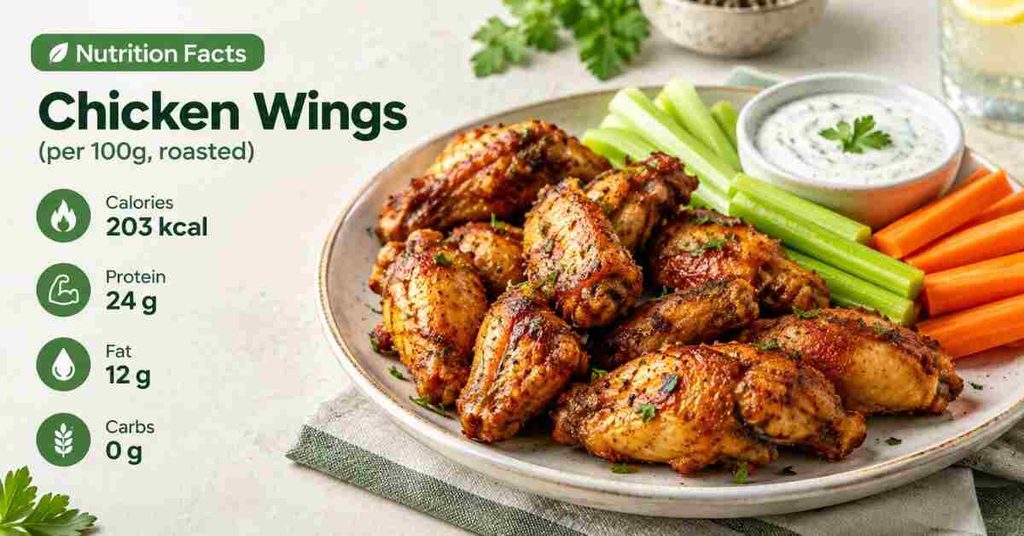
Quick answer: A 100-gram portion of roasted chicken wing with skin has about 254 calories, 24 grams of protein, and 17 grams of fat, with no carbs. Skin-off wings drop to about 203 calories and 8 grams of fat. Batter, frying, and seasoning raise calories, carbs, and sodium.
Wings are small, tasty, and easy to overeat. The numbers change a lot with how they’re cooked and what’s on them. Below, we break down calories, protein, fat, vitamins, and minerals. We also compare cooking styles, skin-on versus skin-off, and sauces. You’ll also see how wings fit into a balanced plate.
Key Takeaways
- 100 grams of roasted wing with skin has about 254 calories, 24 g protein, 17 g fat, and 98 mg sodium.
- Taking off the skin cuts calories and fat. Battered frying and seasoning add calories, carbs, and sodium.
- Wings supply B vitamins and minerals, especially niacin, vitamin B6, and selenium.
- Check labels on sauces and seasonings, and keep the 2,300 mg daily sodium limit in mind.
Chicken Wing Nutrition Facts at a Glance
Here are the numbers for plain, roasted chicken wing meat with skin, per 100 grams (about 3.5 ounces). These values come from USDA data, and bones aren’t counted. (USDA data via Recipal)
Chicken Wings
Roasted · Meat and skin
| Nutrient | Amount | % Daily Value |
|---|---|---|
| Total fat | 17 g | 22% |
| Saturated fat | 5 g | 25% |
| Cholesterol | 141 mg | 47% |
| Sodium | 98 mg | 4% |
| Carbohydrates | 0 g | 0% |
| Protein | 24 g | — |
Daily Values are based on a 2,000-calorie diet.
How much is that in real life? Say you eat 150 grams of cooked wing meat and skin, which is about 5.3 ounces. By simple math from the numbers above, that’s roughly 380 calories, 36 grams of protein, and 25 grams of fat. That’s our calculation, not a USDA figure.
The tip: weigh your cooked wings without the bones, or check the label. “How many wings” depends on the size, so weight is the most reliable measure.
Calories, Protein, and Fat: The Big Three
Calories. Plain roasted wings are energy-dense, mostly because of the skin and the fat in it.
Protein. A 100-gram portion gives about 24 grams of protein. That makes wings a protein food. They are not a low-calorie food.
Fat. The same portion has about 17 grams of fat, split into about 5 grams of saturated fat, 8 grams of monounsaturated fat, and 3.5 grams of polyunsaturated fat. Wings also have no carbs or sugar when they’re plain.
Vitamins and Minerals in Chicken Wings
Wings aren’t just protein and fat. The same USDA data shows a good supply of several B vitamins and minerals per 100 grams of roasted wing with skin:
Vitamins & Minerals
Essential nutrients in roasted chicken wings
| Nutrient | Amount | Daily Value |
|---|---|---|
| Selenium | 26 mcg | 46% |
| Niacin (B3) | 6.3 mg | 40% |
| Vitamin B6 | 0.6 mg | 33% |
| Pantothenic acid (B5) | 0.9 mg | 17% |
| Zinc | 1.6 mg | 15% |
| Vitamin B12 | 0.4 mcg | 15% |
| Phosphorus | 150 mg | 12% |
| Riboflavin (B2) | 0.2 mg | 12% |
Daily Values are based on the figures in this nutrition guide. Individual needs may vary.
Wings are not a big source of calcium, vitamin C, or fiber, so pair them with vegetables and other foods.
How Cooking Method Changes the Numbers
The biggest swings come from how wings are cooked and seasoned. This table compares USDA entries per 100 grams of cooked wing meat and skin:
How cooking changes the nutrition
Same food, four ways to cook it.
Roasted, plain
- 💪 Protein23.8 g
- 🧈 Fat16.9 g
- 🍞 Carbs0 g
- 🧂 Sodium98 mg
Stewed (simmered)
Lowest sodium- 💪 Protein22.8 g
- 🧈 Fat16.8 g
- 🍞 Carbs0 g
- 🧂 Sodium67 mg
Rotisserie, original seasoning
Most protein, most salt- 💪 Protein24.3 g
- 🧈 Fat18.8 g
- 🍞 Carbs0 g
- 🧂 Sodium610 mg
Fried in batter
Most calories- 💪 Protein19.9 g
- 🧈 Fat21.8 g
- 🍞 Carbs10.9 g
- 🧂 Sodium320 mg
Values per serving: [ADD SERVING SIZE]. Source: [ADD SOURCE NAME AND LINK].
Sources: USDA data as shown on getfoodfacts.com, stewed wing, rotisserie wing, and battered fried wing.
Notice two things. First, the batter adds carbs and raises the calories and fat, while protein per 100 grams drops. Second, sodium jumps with seasoning: the seasoned rotisserie wing has about six times the sodium of the plain roasted one, and the battered fried wing has more than three times as much.
Skin On vs. Skin Off
The skin is where much of the fat sits. Here’s the difference per 100 grams of roasted wing:
With skin vs without skin
| Nutrient | 🍗 With skin | 🥗 Without skin |
|---|---|---|
| 🔥 Calories | 254 | 203−51 |
| 💪 Protein | 24 g | 30 g+6 g |
| 🧈 Fat | 17 g | 8 g−9 g |
| 🥓 Saturated fat | 5 g | 2.5 g−2.5 g |
Small tags show the change when you remove the skin. Values per serving: [ADD SERVING SIZE]. Source: [ADD SOURCE NAME AND LINK].
Skin-off wing data comes from USDA data via Recipal. On the 150-gram example from earlier, going skin-off drops the total from about 380 to about 305 calories, and from about 25 to about 12 grams of fat, by our math.
Many people love the crispy skin, and that’s fine. If you’re watching calories or saturated fat, you could remove some of the skin, or eat fewer wings.
Wings vs. Other Chicken Cuts
How do wings stack up per 100 grams of roasted meat with skin?
🌿 Which cut is best for you?
Wing, dark meat, and breast side by side.
| Cut | Calories | Protein | Fat | Sodium |
|---|---|---|---|---|
| 🍗Wing | 254 | 23.8 g | 16.9 g | 98 mg |
| 🍖Dark meat (thigh and leg) | 253 | 26 g | 15.8 g | 87 mg |
| 🥗Breast 🌱 Leanest pick |
197 | 29.8 g | 7.8 g | 71 mg |
Values per serving: [ADD SERVING SIZE]. Source: [ADD SOURCE NAME AND LINK].
Sources: USDA data as shown on getfoodfacts.com for dark meat and breast.
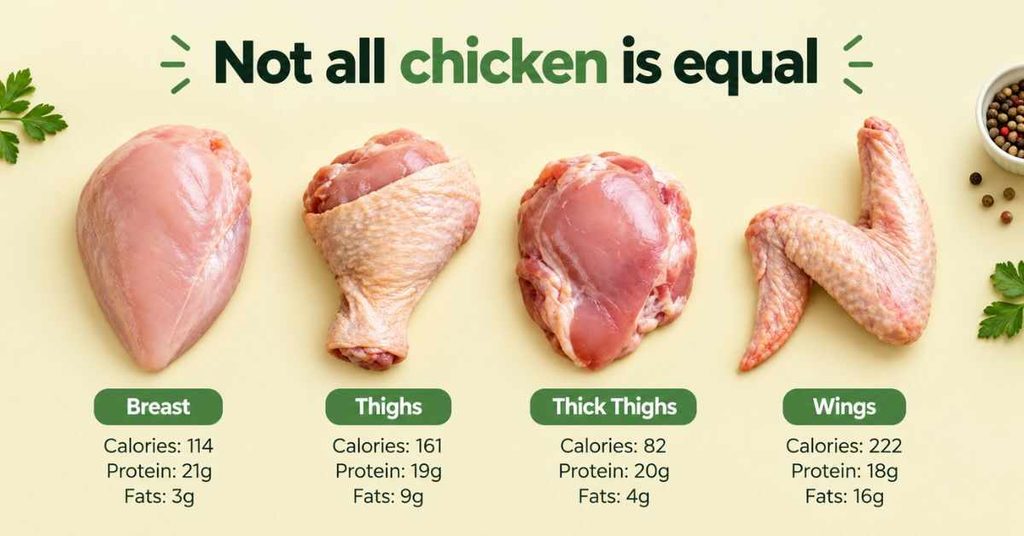
Wings look a lot like dark meat. They’re higher in calories and fat than breast, and a little lower in protein. That’s one reason many dietitians treat wings as an occasional food, not a daily staple.
Sauces, Seasoning, and Sides
The wing itself is only part of the plate. Sauces, glazes, and dips can add sodium, sugar, and fat. We didn’t find a single reliable USDA number for “buffalo sauce” or “BBQ sauce,” because products vary a lot. So read the label on the bottle or the menu.
The seasoned rotisserie wing earlier is a good reminder. It has about 610 mg of sodium per 100 grams, compared with 98 mg for plain roasted wings. The Dietary Guidelines for Americans 2025-2030 keep the limit at less than 2,300 mg of sodium a day for people age 14 and older. (Oklahoma State University Extension)
Dips and sides count too. Ranch, blue cheese, fries, and sugary drinks can double the calories of a meal. Add some crunchy vegetables or a salad to round out the plate.
Are Chicken Wings Healthy?
It depends on how you eat them. Wings give you protein, B vitamins, and minerals. But with the skin on, they also carry saturated fat. The Dietary Guidelines for Americans 2025-2030 kept the limit of less than 10 percent of calories from saturated fat, which is about 20 to 22 grams a day on a 2,000-calorie diet. (Harvard Nutrition Source)
On our 150-gram example, roasted wings with skin carry about 7.5 grams of saturated fat, or roughly a third of that daily limit, by our math. That’s fine as part of a varied day, but it adds up if you eat wings often or add fried sides and creamy dips.
Your overall eating pattern matters more than one meal. If you have high blood pressure, high cholesterol, or heart disease, ask your doctor or dietitian how often wings fit into your plan.
Tips for Enjoying Wings in a Balanced Way
- Choose baked, roasted, or air-fried wings when you can. The USDA data shows plain roasted wings have fewer calories, less fat, and no carbs, compared with battered fried wings.
- Go easy on sauces. Ask for sauce on the side and toss a little.
- Eat some of the skin, not all. Or remove the skin from a few wings.
- Weigh a portion. Aim for a portion you can measure, not a bottomless basket.
- Fill the plate. Add celery, carrots, cucumber, or a side salad.
- Drink water instead of sugary drinks.
- After a workout? Wings can fit, but balance the plate.
Food Safety: Cook Wings to 165°F
Always cook chicken wings to a safe internal temperature. The U.S. government’s food safety chart lists 165°F (74°C) for chicken, including wings, and says to use a food thermometer to check. It also says to reheat leftovers to 165°F. (FoodSafety.gov) Check the thickest part of the wing, away from the bone.
Conclusion
Chicken wings can fit into a balanced plate. They give you protein, B vitamins, and minerals, but they also carry fat, and sauces and batter can add sodium and carbs. Choose roasted or baked, watch the sauces, weigh your portion, and fill the plate with vegetables. For more nutrition guides, explore our Weight Loss & Nutrition category.
Sources
- USDA FoodData Central data for roasted wing meat and skin, as shown on Recipal
- USDA data for roasted wing meat only, as shown on Recipal
- USDA data for roasted wing meat and skin, as shown on getfoodfacts.com
- USDA data for stewed wing, as shown on getfoodfacts.com
- USDA data for rotisserie wing, as shown on getfoodfacts.com
- USDA data for battered fried wing, as shown on getfoodfacts.com
- USDA data for roasted dark meat, as shown on getfoodfacts.com
- USDA data for roasted breast, as shown on getfoodfacts.com
- Oklahoma State University Extension, The New Dietary Guidelines for Americans (2025-2030)
- Harvard Nutrition Source, Dietary Guidelines for Americans 2025-2030
- FoodSafety.gov, Cook to a Safe Minimum Internal Temperature
Disclaimer: This article is for informational purposes only and is not a substitute for professional medical advice, diagnosis, or treatment. Always consult a qualified healthcare provider before changing your diet, exercise routine, or health regimen. Read our full Medical Disclaimer for more details.
Written by the CleanLiveHealth Team.
FAQs
It depends on weight and cooking style. Per 100 grams, plain roasted wings with skin have about 254 calories. Skinless roasted wings have about 203, and battered fried wings have about 324. Weigh your portion for the best estimate.
Plain roasted wings with skin have about 24 grams of protein per 100 grams. Without skin, they have about 30 grams. Battered fried wings have less, at about 20 grams, because the batter adds other ingredients.
Plain roasted wings have 0 grams of carbs. Battered fried wings have about 11 grams per 100 grams, and many sauces add sugar. Check the label on any sauce or dry rub.
Plain roasted wings are fairly low, at about 98 mg per 100 grams. Seasoning, batter, and sauces can raise it a lot. The seasoned rotisserie wing in the USDA data has about 610 mg per 100 grams.
By the numbers, yes. USDA data shows plain roasted wings have fewer calories, less fat, no carbs, and less sodium than battered fried wings. “Healthier” also depends on sauces, portion size, and the rest of your diet.
