Want stronger arms but have no dumbbells, bands, or bar? Your home already has more to work with than you think.
Quick answer: A biceps workout at home without equipment is possible. Use towel curls, backpack curls, doorway rows, and slow isometric holds. Do 2 to 4 sets per move, two days a week, and make the last reps hard while keeping good form. Progress by adding reps, slowing down, or using one arm.
Most arm exercises need something to pull or lift. That’s why training your biceps at home feels tricky. Still, a backpack, a towel, a few water jugs, and a solid door frame can do the job. Below, we share nine moves, six ways to make them harder, and a simple two-day plan. We also share the honest limits, so you know what to expect.
Key Takeaways
- You can train your biceps with a backpack, a towel, water jugs, a door frame, or just your own hands.
- Slow lowering, pauses, and hard last reps make light loads work harder.
- Two sessions a week, with rest days between, is a solid start.
- Without heavy weights, strength gains have a ceiling. Set realistic goals.
Can You Really Train Biceps Without Equipment?
Yes, with a catch. Your biceps work when you curl something up or pull something toward you. Push-ups and planks don’t do that. So you need something to lift or pull on, and everyday items can fill that role.
The good news is that effort matters a lot. A 2017 meta-analysis found that light and heavy loads built similar muscle size when every set was taken to momentary failure. (Schoenfeld et al., 2017) Those studies used gym weights, not towels or backpacks, so evidence for home items is limited. Still, it supports one idea: hard sets matter more than fancy gear.
Here is the honest limit. The same review found that heavy loads gave bigger gains in one-rep max strength. If your goal is to lift as much as possible, you’ll eventually want heavier weights. For everyday strength and good arm shape, home training is a solid start.
How Your Biceps Work (and Why It Matters)
Your biceps have two heads and sit at the front of your upper arm. It turns your forearm palm-up and helps bend your elbow, but a deeper muscle called the brachialis does most of the elbow bending. (StatPearls) That’s why we mix grips below: palms up, palms facing in, and palms down.
The triceps, on the back of your arm, works as the biceps’ opposing muscle. Push-ups mainly train your triceps, chest, and shoulders, not your biceps. So we treat them as a helper, not a biceps move.
Biceps Workout at Home Without Equipment: 9 Moves That Work
For each move, choose a load or effort where the last two or three reps feel hard. Move smoothly and never swing. Keep your elbows close to your sides on curls.
Household-Item Moves
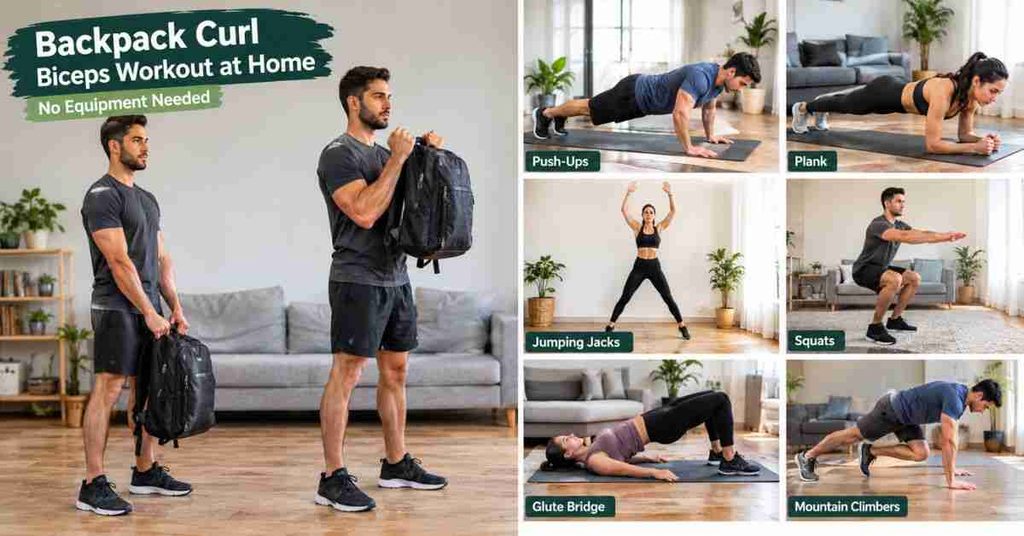
1. Backpack Curl
Works: biceps and forearms.
Pack a bag with books until 10 to 15 reps feel hard. Hold the top handle with one hand, elbow by your side. Curl up, pause, and lower slowly.
Easier: Use a lighter bag. Harder: Take four seconds to lower.
2. Water-Jug Hammer Curl
Works: biceps, brachialis, and forearms.
Hold a sealed jug in each hand with palms facing each other. Curl both up, then lower slowly. A liter of water weighs about one kilogram (2.2 pounds), so you can scale the load easily.
Easier: Use smaller bottles. Harder: Curl one jug at a time and lower slowly.
3. Towel Curl
Works: biceps (your leg supplies the resistance).
Sit on a chair and loop a towel under one foot. Hold both ends with palms up. Press your foot into the towel as you curl your hands toward you, then lower while still pressing.
Easier: Press lightly. Harder: Press harder and move slower. Keep the tension steady, since you set the resistance yourself.
4. Backpack Reverse Curl
Works: forearms and upper arm.
Hold the bag’s handle with your palm facing down. Keep your wrist straight and curl up. Use less weight than in the regular curl.
Easier: Use a lighter bag. Harder: Lower for four slow seconds.
Bodyweight Pulling Moves
5. Doorway Row
Works: biceps and upper back.
Stand in an open doorway and grip both sides of a solid door frame at chest height. Walk your feet forward and lean back with a straight body. Pull your chest toward the frame, then lower slowly.
Easier: Stand more upright. Harder: Lean back further or pull with one hand. Use a solid frame only. Stop if it creaks or shifts.
6. Underhand Table Row
Works: biceps and back.
Lie on the floor under a heavy, solid table. Grip the edge with your palms facing you and arms straight. Keep your body in one line and pull your chest toward the table, then lower slowly. The underhand grip lets your biceps help more.
Easier: Bend your knees and keep your feet flat. Harder: Straighten your legs and pause at the top. Never use a glass, folding, or wobbly table.
Slow and Isometric Moves
7. Self-Resisted Curl
Works: biceps (your other hand supplies the load).
Hold your right arm at your side, palm up. Rest your left hand on your right wrist. Curl your right hand up for five slow seconds while your left hand presses down. Then lower for five seconds. Switch arms.
Easier: Press lightly. Harder: Press harder while keeping the pace slow. Breathe and keep your neck relaxed.
8. Isometric Backpack Hold
Works: biceps.
Curl a loaded backpack until your forearm sits at about a right angle to your upper arm. Hold for 20 to 30 seconds, then lower. Keep your elbow still.
Easier: Hold for 10 to 15 seconds. Harder: Use a heavier bag or hold with one arm.
9. Two-Up, One-Down Backpack Curl
Works: biceps.
Use a heavier bag than usual. You need to curl it up with both hands, then move it to one hand and lower it gradually for four to five seconds. Switch hands each rep.
Easier: Lower for three seconds. Harder: Lower for six seconds and pause at the bottom.
How to Make Each Move Harder Without Adding Weight
When a bag or jug feels too light, change how you lift it. Try one of these at a time:
- Slow the lowering. Take three to five seconds to come down.
- Pause at the hardest point. Hold for one or two seconds.
- Add reps. Move up gradually, one or two reps per week.
- Go one arm at a time. This doubles the load on each arm.
- Shorten your rest. For example, drop from 90 to 60 seconds.
- Finish with hard last reps. Research on lighter loads points to effort as the key. Stop when your form would slip, and while you’re learning, keep a rep or two in reserve.
If the top of your plan feels easy even with these tricks, adjustable dumbbells or a pull-up bar can help later. That’s an upgrade, not a requirement.
A Simple 2-Day Weekly Biceps Plan
The CDC says adults need muscle-strengthening activity on 2 days each week. (CDC) Our plan uses two short sessions of about 20 minutes. Do them on non-consecutive days, such as Tuesday and Friday. Rest 60 to 90 seconds between sets.
Day A
| Move | Sets and reps |
| Backpack Curl | 3 sets of 10 to 15 |
| Underhand Table Row | 3 sets of 8 to 12 |
| Self-Resisted Curl | 2 sets of 5 slow reps per arm |
Day B
| Move | Sets and reps |
| Water-Jug Hammer Curl | 3 sets of 10 to 15 |
| Doorway Row | 3 sets of 8 to 12 |
| Isometric Backpack Hold | 3 holds of 20 to 30 seconds |
| Two-Up, One-Down Curl | 2 sets of 5 per arm |
When you reach the top of the rep range on every set with good form, use one of the six levers above. Write down your reps each session so you can see your progress.
Remember that the CDC guideline covers your whole body, not just your arms. Add legs, push-ups, and core work on other days.
Warm-Up and Safety Checks
Warm up for three to five minutes. A Mayo Clinic sports medicine doctor suggests a dynamic warm-up, such as jumping jacks or leg lifts, instead of stretching cold muscles, and says to stretch after your workout. (Mayo Clinic Sports Medicine) Try arm circles, shoulder rolls, light marching, and 10 slow curls with no load.
Then run through these safety checks:
- Test doors and tables first. Use only a solid frame and a heavy table. Never pull on anything loose, hollow, glass, or wet.
- Secure your loads. Seal jugs and zip bags, and don’t overload a bag that could split.
- Stop for sharp pain. Muscle burn is normal. Pain in your elbow, shoulder, or wrist is not.
- Wear non-slip shoes or use a mat for the rowing moves.
- Talk to a doctor first if you have an arm injury or a health condition that limits exercise.
Common Mistakes to Avoid
- Swinging the weight. Momentum steals work from your biceps. Slow down.
- Letting your elbows drift forward. Keep them close to your sides.
- Dropping the weight fast. The lowering part builds strength too.
- Training biceps every day. Muscles need rest, so leave at least a day between sessions and sleep well.
- Ignoring your back and triceps. Balanced training keeps your shoulders happier.
- Chasing “massive arms” promises. Home training builds strength and shape. Results vary by person.
FAQs
Yes, to a point. Studies show effort matters more than the type of load, but those studies used weights. Evidence for towels and backpacks is limited. Expect real strength gains at first, then slower progress without heavier loads.
Two days a week is a solid start. The CDC recommends muscle-strengthening on at least 2 days each week. Leave a rest day between sessions, and add other muscle groups on other days.
Aim for three sets of 10 to 15 reps on curls, and 8 to 12 on rows. Pick a load where the last reps feel hard, but your form stays clean. Rest 60 to 90 seconds between sets.
A backpack with books, sealed water jugs, and a towel all work. A liter of water weighs about one kilogram. Avoid items that could split or slip, and check that handles and straps feel secure.
Not mainly. The triceps oppose the biceps, and push-ups rely on elbow-straightening muscles. Your biceps assist a little. For direct biceps work, use curls, rows, and holds.
Conclusion
Stay consistent and select moves that you can safely perform while working out your biceps at home without equipment. Use a backpack, a towel, or your own hands, and make each rep slow and hard. Train two days a week, track your reps, and rest between sessions. For fuel that supports your training, explore our Weight Loss & Nutrition category.
Sources
- Schoenfeld et al., Strength and Hypertrophy Adaptations Between Low- vs. High-Load Resistance Training: A Systematic Review and Meta-analysis
- StatPearls, Anatomy, Shoulder and Upper Limb, Biceps Muscle
- CDC, Adult Activity: An Overview
- Mayo Clinic Sports Medicine, The Right Way to Get Your Body Flexible
Disclaimer: This article is for informational purposes only and is not a substitute for professional medical advice, diagnosis, or treatment. Always consult a qualified healthcare provider before making changes to your diet, exercise routine, or health regimen. Read our full Medical Disclaimer for more details.
Written by the CleanLiveHealth Team.
